I’m using Internet Identity (identity.ic0.app) for authentication in my dapp . The app works perfectly in regular browsers like Chrome, Firefox, and Safari. However, when I try to log in from the **LinkedIn mobile app, the authentication fails and give me this message
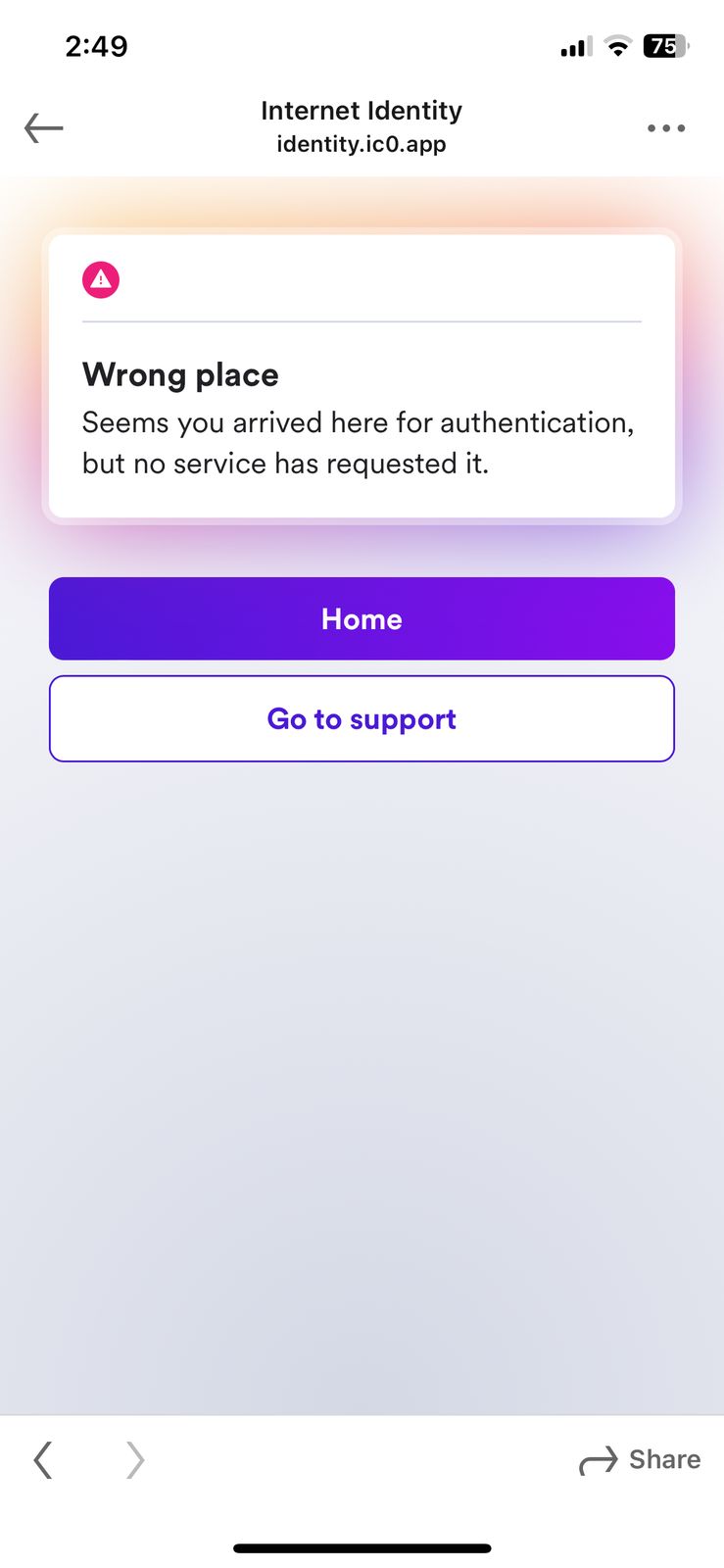
- This only happens inside LinkedIn’s in-app browser. this is my use-auth page import { AuthClient } from “@dfinity/auth-client”;
import React, { createContext, useContext, useEffect, useState } from “react”;
import { canisterId as MercxId, createActor as createMercxActor } from “…/…/declarations/mercx_backend”;
import { canisterId, createActor } from “…/…/declarations/icrc1_ledger_canister”;
import { canisterId as icrcIndexCanisterId, createActor as createIndexActor } from “…/…/declarations/icrc1_index_canister”;
import { canisterId as icpCanisterId, createActor as createIcpActor } from “…/…/declarations/icp_ledger_canister”;
import { canisterId as tommyCanisterId, createActor as createTommyActor } from “…/…/declarations/tommy_icrc1_ledger”;
import { canisterId as kycCanisterId, createActor as createKycActor } from “…/…/declarations/kyc”;
// Create a React Context for sharing authentication status across the component tree
const AuthContext = createContext();
// Function to determine the correct identity provider URL based on environment and browser
export const getIdentityProvider = () => {
let idpProvider;
// Safeguard against server rendering
// Check if the code is running in a browser environment
if (typeof window !== “undefined”) {
// Determine if the environment is local (not production)
const isLocal = process.env.DFX_NETWORK !== “ic”;
// Safari does not support localhost subdomains
// Check if the user’s browser is Safari to handle specific limitations
const isSafari = /^((?!chrome|android).)*safari/i.test(navigator.userAgent);
if (isLocal && isSafari) {
// Safari handling for local development environment
idpProvider = http://localhost:8001/?canisterId=${process.env.CANISTER_ID_INTERNET_IDENTITY};
} else if (isLocal) {
// General handling for non-Safari browsers in local development
idpProvider = http://${process.env.CANISTER_ID_INTERNET_IDENTITY}.localhost:8001;
}
}
return idpProvider;
};
// Default options for the authentication client
export const defaultOptions = {
/**
- @type {import(“@dfinity/auth-client”).AuthClientCreateOptions}
/
createOptions: {
idleOptions: {
// Set to true if you do not want idle functionality
// Opt to disable idle functionality for the auth client
disableIdle: true,
},
},
/* - @type {import(“@dfinity/auth-client”).AuthClientLoginOptions}
*/
loginOptions: {
// Specify the identity provider determined by getIdentityProvider
identityProvider: getIdentityProvider(),
},
};
/**
*
- @param options - Options for the AuthClient
- @param {AuthClientCreateOptions} options.createOptions - Options for the AuthClient.create() method
- @param {AuthClientLoginOptions} options.loginOptions - Options for the AuthClient.login() method
- @returns
*/
// Custom hook to manage authentication state
export const useAuthClient = (options = defaultOptions) => {
const [isAuthenticated, setIsAuthenticated] = useState(false);
const [authClient, setAuthClient] = useState(null);
const [identity, setIdentity] = useState(null);
const [principal, setPrincipal] = useState(null);
const [whoamiActor, setWhoamiActor] = useState(null);
const [icrcIndexActor, setIcrcIndexActor] = useState(null);
const [icpActor, setIcpActor] = useState(null);
const [mercx_Actor, setMercxActor] = useState(null);
const [tommy_Actor, setTommyActor] = useState(null);
const [kycActor, setKycActor] = useState(null); // KYC actor
useEffect(() => {
  // Initialize AuthClient
  // Create an AuthClient instance when the component mounts
  AuthClient.create(options.createOptions).then(async (client) => {
    updateClient(client);
  });
}, );
// Function to handle user login
const login = () => {
authClient.login({
…options.loginOptions,
onSuccess: () => {
updateClient(authClient);
  },
});
};
// Update local state with the new auth client details
async function updateClient(client) {
const isAuthenticated = await client.isAuthenticated();
setIsAuthenticated(isAuthenticated);
const identity = client.getIdentity();
setIdentity(identity);

const principal = identity.getPrincipal();
setPrincipal(principal);

setAuthClient(client);

// Create an actor with the authenticated identity
const actor = createActor(canisterId, {
  agentOptions: {
    identity,
  },
});

setWhoamiActor(actor);
const indexActor = createIndexActor(icrcIndexCanisterId, {
  agentOptions: {
    identity,
  },
});
setIcrcIndexActor(indexActor);

const IcpActor = createIcpActor(icpCanisterId, {
  agentOptions: {
    identity,
  },
});
setIcpActor(IcpActor);

const MercxActor = createMercxActor(MercxId, {
  agentOptions: {
    identity,
  },
});
setMercxActor(MercxActor);

const tommyActor = createTommyActor(tommyCanisterId, {
  agentOptions: {
    identity,
  },
});
setTommyActor(tommyActor);

// ✅ Create the KYC Actor
const kycActor = createKycActor(kycCanisterId, {
  agentOptions: {
    identity,
  },
});
setKycActor(kycActor);
}
async function logout() {
await authClient?.logout();
await updateClient(authClient);
}
return {
isAuthenticated,
login,
logout,
authClient,
identity,
principal,
whoamiActor,
icrcIndexActor,
icpActor,
mercx_Actor,
tommy_Actor,
kycActor,// Return KYC actor
};
};
/**
- @type {React.FC}
*/
// Provider component to wrap the application and provide auth state via context
export const AuthProvider = ({ children }) => {
const auth = useAuthClient();
return <AuthContext.Provider value={auth}>{children}</AuthContext.Provider>;
};
//A simple hook that allows any component within the context provider to access the auth state and methods easily.
export const useAuth = () => useContext(AuthContext);